Print Blog RSS

PGPF Blog

National Debt Crosses $11 Trillion

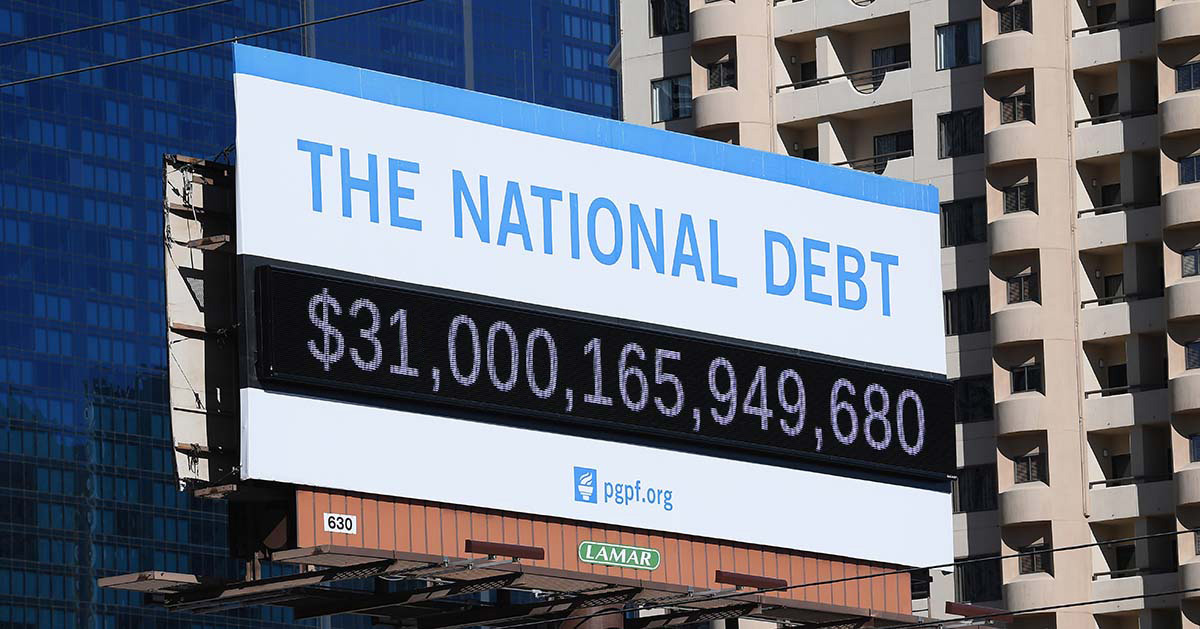
America's national debt has punched a new hole in the stratosphere. PGPF's NationalDebt Twitter just clocked in at $11,033,157,578,669.78-the first time it's crossed $11 trillion.

As Politico reports, "The whopping number has major ramifications for President Barack Obama, who is trying to push through a raft of big-ticket bills on health care, energy, education and climate change - while also attempting to stabilize the swooning economy."

According to CBS News' Hotsheet, the national debt amounts to $36,000 each for every man, woman and child in America. But if you consider the government's off-the-balance sheet liabilities and unfunded retirement and health obligations, $11 trillion is just the tip of an iceberg. The real national debt is actually more than $56 trillion-or $483,000 per U.S. household.


2 Comments

  1. Re: National Debt Crosses $11 Trillion

    >>But if you consider the government's off-the-balance sheet liabilities and unfunded retirement and health obligations, $11 trillion is just the tip of an iceberg. The real national debt is actually more than $56 trillion-or $483,000 per U.S. household.<<

    The key word in the above quote is "obligations."  These obligations neither are signed nor verbal contracts.  These obligations, at best, are slightly better than promises, and we all know how well our politicians keep their promises.  In perverse irony, our politicians resist reform because they know it shall entail breaking previous promises.

    Our real (public) debt stands at around $7 trillion today.  These $56 trillion of "unfunded retirement and health obligations" are just that, viz., unfunded promises.  They are straw man, imagination.  It is impossible for us to fund these $56 trillion of projected unfunded liabilities.  To talk of them as "real" is counterproductive because most people, consciously or not, know they are not real.  This $56 trillion number is useful only in that it shows why reforms absolutely are necessary.  Beyond that, it is a meaningless (imaginary) number.  The Federal government simply cannot collect the revenues to fund such liability above and beyond its current commitments/spending.

    Today we have about $4.3 trillion of the future underfunded retirement and health obligations "funded" via the debt (interest-bearing IOUs) held in our trust funds.  This projects to grow to $7.8 trillion by 2019.  They will struggle just to pass reforms necessary to collect from taxpayers "again" the taxes necessary to return these $7.8 trillion borrowed from taxpayers to taxpayers.  They plan to renege on these $7.8 trillion of "obligations," over time, by increasing taxes and reducing benefits.  In other words, for what some (millions) were promised, they will pay in more and receive less.

    Outraged taxpayers at AIG, really, is quite quaint.  This is how people react when they're feeling an injustice upon them.  The only reason there is no taxpayer outrage over how our lawmakers are handling their surplus Social-Security and Medicare deductions, is because taxpayers are not feeling these effects, yet.  If taxpayers can get this excited over a mere misused $165 million by AIG, I wonder what level of excitement they will attain once they feel the misuse of $7.8 trillion of their tax dollars by the USG?

    The real reforms necessary will not come until lawmakers start collecting more from us in taxes.  I'll give President Obama that---he certainly is raising our taxes---but not nearly enough to fund the promises forward.  His FY2010 Budget proposes to take our public debt from »$8.4 trillion in 2009 to $15.4 trillion in 2019 and our trust-fund debt from »$4.3 trillion in 2009 to $7.8 trillion in 2019.  If this is "change we can believe in," count me an unbeliever.  That is a national debt growth from $12.7 trillion in 2009 to $23.2 trillion in 2019.

    The points are President Obama's first budget:

    1) does not propose near the tax increases or spending cuts to rein in debt
        growth, let alone pay down debt.
    2) continues to borrow payroll surplus and the annual interest due on these
        accumulated surpluses.

    People need to understand that unless they are hearing about huge tax increases on ALL taxpayers and/or huge spending cuts across the board, then any "reform" talk, is but lip service to the word.

    What's worse?  A felt invisible, a felt opaque, or a felt transparent injustice?  Change, in and of itself, is not "reform."  Mr. Obama is making many changes, but I've yet to see any reform necessary to remove these imaginary $56 trillion of unfunded obligations from the projections.  A "reserve fund," of $630 billion (which builds to this over ten years) is but a mere 1.1% down payment on these projected $56 trillion of unfunded obligations.  Hardly seems a serious effort to me.

    Moreover, how does one build a "reserve fund" with borrowed dollars?  "A $630 billion reserve fund" sounds real nice, even like change, until one considers that he (Mr. Obama) proposes to increase our public debt by $7 trillion over these same ten years of building this reserve fund.  Why not just increase our public debt only by $6.37 trillion over the next ten years instead?

    This nonsense shall crash as sure as our financial giants crashed for their nonsense.  And guess who our Federal government thinks will come to its rescue?  Mr. Obama said yesterday, "We don't need these Ponzi schemes, even if they are legal."  First, no Ponzi scheme is legal.  Second, the "legal" he was alluding to is the unified budget used by our Federal government.  Yet, he continues to exploit this unified-budget practice.  In fact, by supporting that our trust-fund debt grows by another $3.5 trillion over the next ten years, he is fully exploiting this "legal Ponzi scheme" we call the unified-budget.

    What the fall of home values was to the financial giants, so will retiring baby boomers be to the Federal government---except on a  MUCH  larger scale.

  2. Why the $56T is imaginary
    The graph below is for illustration only.  It does not attempt to factor in the entire realities moving forward.  E.g., it assumes this $56T gap remains constant through 2039, an unlikely scenario.  It shows the GDP necessary (w/out or w/ borrowing) to fund this $56T imbalance over the next 30 years.

    The graph assumes a "normal" 18.5% (64-year average) spending of GDP.  Onto that we add the cost of funding this $56T linearly over the next 30 years.  Moreover, we add the cost of redeeming linearly the HI-Trust IOUs (from 2013-19) and the cost of redeeming the OASDI-Trust IOUs (from 2028-41.)  Furthermore, it largely ignores the burden of our gross (national) debt, which is the gross interest due annually.  The annual Real GDP used is in accordance with the projections in the latest CBO Long Term Budget Outlook (Dec.07).

    Funding $56T gap.jpg

    We are not going to give the USG (United States Government) from 34% to 29% of our GDP from now to 2039 in order to fund this $56T gap.  Reform is not about funding this $56T; rather, reform is about eliminating this $56T gap.  This distinction between funding or eliminating may be subtle for some, however it is a major distinction that voters shall face, and this facing it cannot come soon enough.  We will not eliminate this $56T imbalance by funding it; for, this would require giving the USG sustained levels of our GDP over the next 30 years without any historical evidence suggesting that we would tolerate, let alone accept, giving the USG this much of our GDP.  After all, people today are lamenting about the level of their USG taxes, when the feeling (because of the borrowing) is in the neighborhood of a mere 15% of GDP.  One only can imagine the outcry should this feeling double+ in its intensity.

    The fear is that absent real reform, the Congress will borrow (from the public) to cover the $56T gap.  With this (and in this example,) we'd remain taxed at the 18.5% level of GDP, but the USG actually would budget/consume (via borrowing) to achieve the levels of GDP shown on the graph.  This will not, indeed, cannot happen.

    Were the Congress able to do this, our public debt by 2039, at minimum, would be around $68T.  At 4%, the annual interest on such debt would be $2.7T.  In 2039, 18.5% of GDP (the USG's non-borrowed income) would be $4.4T.  Thus, by 2039, 61% of its non-borrowed income would go out as interest on its debt.  More to the point is that if the Congress attempted to do this, investors in this growing debt would demand higher returns.  If at 8%, the annual interest would be $5.4T by 2039, with the USG's non-borrowed income still at $4.4T.  See the problem?

    This is why this $56T is imaginary.  If the Congress tries to collect the GDP necessary to fund it, voters will revolt over the high taxes.  If the Congress tries to borrow the funds necessary to fund it, voters will revolt over the sustained and enormous deficits/borrowing.  Congress' only viable options are to eliminate the imbalance by changes in law and/or to change our behavior and expectations.  We never will see this so-called $56T of unfunded liabilities.  It is an abstract number soundly derived, proving not that funding it is necessary but that reform is necessary.

    If the President and Congress can convince American taxpayers to give the USG even 25% of GDP on a sustained basis, it will be a miracle.  President Obama proposes annual outlays averaging at 22.6% of GDP over the next ten years.  This is a whopping 4.3% above the post-WWII historical average.  Moreover, his annual deficits "proposed" over these ten years average to 3.9% of GDP.  Thus, the taxation level we will feel over these tens years is at the 18.7% level of GDP.  Then, too, of course, these deficits are understated because the USG continues to borrow our annual trust surpluses (from payroll deductions) and the annual interest due on those accumulated surpluses, to prop up the spending levels and "reduce" the deficits.  If we add this to the deficits, as we should, then we actually are feeling it only at the 16.7% GDP level!  I.e., if the USG did not have these surpluses to borrow, then it would have to raise the revenue otherwise (more taxes and/or public borrowing) to fund this level (22.6%) of GDP spending.  And, mind you, we are not here considering the collection of revenues necessary to fund this imaginary $56T gap.  In other words, even with averaged annual borrowing at 5.9% of GDP over the next ten years, this $56T gap remains unaddressed, except in "proposed/projected savings" like from electronic medical records, price controls/fixing, reduced payments to physicians, growing premiums, healthier lifestyles, preventive care, health-care rationing,....  Certainly we can achieve savings along these lines, however it would be careless to overstate these "potential" savings.

    The long short?  We will know the reform is real when taxes on all taxpayers spike up and the entitlement/social spending of the USG plummets.  As this plays out, the Left will attempt to collect as much of our GDP as it can, so as to limit reductions in the USG's entitlement/social spending.  Question is, how much of their GDP will Americans agree to give to the USG, especially when adding more debt to books of the USG no longer is an option and we the people are feeling the full+ load of budgeted GDP spending?

    The "+" in the full load is this: When there is principal (IOU) redemption from the trust funds, the USG cannot count this redemption as GDP spending again, since they already once counted those "savings" as GDP spending and consumed the cash.  To count IOU redemption again as GDP spending is like being able to pay for a product priced at $100 by handing the cashier the same $50 bill twice.  Thus, the day approaches when the USG will budget to consume, say, 25% of GDP, but the USG must collect even more than that in accordance with the amount of trust principal redeemed---or the exact opposite of what Americans had been feeling in the previous seven decades, when borrowing reduced what Americans felt (averted what they should have been feeling) at a given level of GDP spending by the USG.

    Optimism is a dual-edged sword.  On the one edge, it leads to good results, particularly, in one's mental/spiritual state of being.  On the other edge, it leads to bad results.  When optimism is blind or irrational, it, as a rule, paralyzes us from taking necessary action in the present to justify the optimism.  Too many Americans have been and remain in this blind/irrational mode of optimism as concerns the borrowing and spending habits of the USG.  This is because the borrowing insulates them from feeling the immediate effects of this spending not supported by taxes.  That is, they're getting a lot "now" without paying for it, or so they think!

    The blind/irrational optimism is that some (millions) think we can let the USG continue to borrow (to include borrowing to pay the annual interest due on the accumulated borrowing,) without future ill effect.  Little is farther from truth/reality.  When the wells from which to borrow dry up, as they shall, Americans will be left to feel the true cost of the accumulated debt.  From 1975-2008, Americans have not felt this cost, on just the public debt, to the tune of $5.3 trillion.  Since our public debt at FY2008's end stood at $5.8 trillion, it should be obvious that the vast majority of our public debt is the result of borrowing to "pay" the annual due interest on the public debt.  The days of this "free lunch" approach their end, and it pulls on this optimists' ability to be optimistic about it.  The piper remains knocking, perhaps now pounding, at the door.  Soon, the piper will bust down the door and say, "It's time to pay, not only 'for' the accumulated debt but to reduce the accumulated debt as well," and all of that at reasonable levels of GDP consumption by the USG!  This is not the "bright future" that our sitting President, understandably, paints for us to embrace.  Fearing the analogy is too obscure, the "piper" is the voters.  No other "entity" can control the U.S. Congress and its beastly appetite.

    By proposing a budget with large projected deficits over the next ten+ years, Mr. Obama does our Nation a disservice, by merely postponing the inevitable, kicking the can down the road.  Of course, he has three, maybe seven, more budgets with which to challenge the Congress into true reforms that both will bring the USG budgeting into true balance and reduce the debt-to-GDP ratio.  Contrary to "conventional" wisdom, the budget buck does not stop on the President's desk.  It stops in the Congress' chambers.  The President cannot spend a dime without Congressional approval, and the Congress can make law without the President's signature, by overriding any presidential veto via two-thirds majority vote in both chambers on the vetoed bill.

    The Congress is the problem, and Mr. Obama does no service for the public by feigning responsibility/accountability for things beyond the realm of Constitutional powers granted to the Branch of government he heads.  Nor is this feigned responsibility/accountability neutral; for it "serves" to detract from where voter focus ought to be and needs to be, viz., on the Congress.  Perhaps, this is no coincidence but, instead, a calculated attempt to help see his proposed deficit spending glide through the Congress and into law.

    The $56T of unfunded liabilities number serves rightly only as evidence of needed reforms.  Used in any other way is counterproductive.  For, we never will see that level of debt against our projected GDPs over the next few+ decades.  Financial/economic collapse would preclude reaching such a debt-to-GDP ratio.


Add a comment »