




Deficits Will Remain over $1 Trillion for the Next Decade


Annual deficits are projected to remain above $1 trillion for the next 10 years, according to the Office of Management and Budget (OMB), which released its annual mid-session review on Friday. The report — which takes into account the Administration’s economic forecast and assumes the President’s legislative agenda is enacted — showed somewhat lower deficits than were anticipated earlier this year, owing to higher projections for economic growth. Nonetheless, the nation will remain on an unsustainable fiscal trajectory due to a structural mismatch between spending and revenues.
OMB estimates that the deficit for 2021 will be $3.1 trillion, $0.6 trillion lower than the $3.7 trillion deficit projected in May. Over the next 10 years, the cumulative deficit would total $13.9 trillion if the President’s policies were carried out; that total is $0.6 trillion lower than estimated in May. Nevertheless, debt held by the public relative to the size of the economy is still anticipated to exceed its all-time high of 106 percent of gross domestic product within the next few years.
While those small improvements in deficits are welcome, this OMB report is the latest reminder of the nation’s unsustainable fiscal trajectory, which has only been exacerbated by the COVID-19 pandemic. As the economy continues to recover from the pandemic, lawmakers should start working to address the challenges that contribute to the rising debt and put America on a better fiscal path.
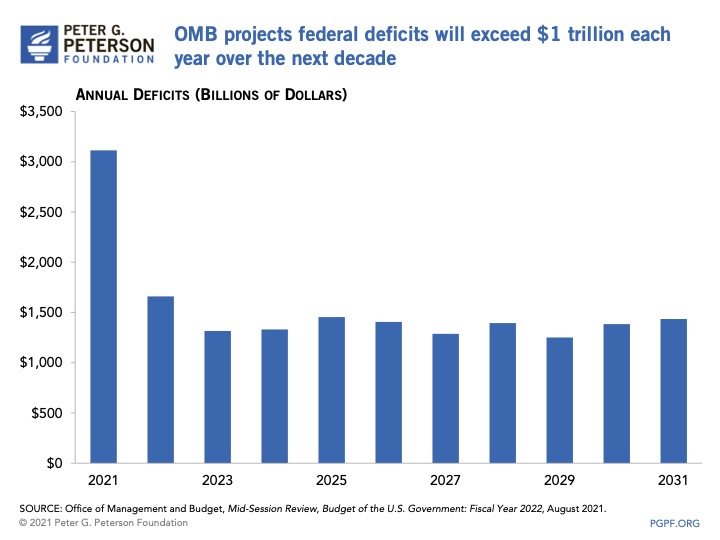
Image credit: Getty Images
Further Reading

Quarterly Treasury Refunding Statement: Borrowing Could Rise Soon
The U.S. Treasury has signaled its intention to add $1.4 trillion in new debt between July and December.

What Are Interest Costs on the National Debt?
Interest costs are on track to become the second largest category of spending in the federal budget.
7 Charts That Illustrate America’s Growing Fiscal Stress
America’s fiscal situation is daunting, with key budgetary warning signs and hurdles approaching in the near term.