




Should Stimulus Checks Go to Higher-Income Americans?

As lawmakers continue to explore policies to help the nation recover from the economic damage caused by the pandemic, a key part of the discussion is how stimulus checks should be structured and targeted for maximum effectiveness. Looking at recent spending and saving trends offers some clues.
In late December, the federal government enacted a second round of Economic Impact Payments in Division N of the Consolidated Appropriations Act, 2021. Also known as stimulus checks, such payments totaled $600 per person ($1,200 for married couples) plus another $600 per qualified child. As of January 29, about $135 billion of those payments had been sent out — reflecting about 80 percent of the estimated total cost of $164 billion.
That second round of payments successfully boosted consumer spending among lower-income households but had little impact on consumer spending for higher-income groups, according to a recent analysis by Opportunity Insights. That research suggests that households earning less than $46,000 a year will spend $126 of each payment received within the first month that they receive it — contributing to an increase in consumer spending among that income group of nearly 8 percentage points. Higher-income households earning more than $78,000 annually, however, will only spend $45 of each payment over that same time period, contributing to a 0.2 percentage point increase in consumer spending among that group.
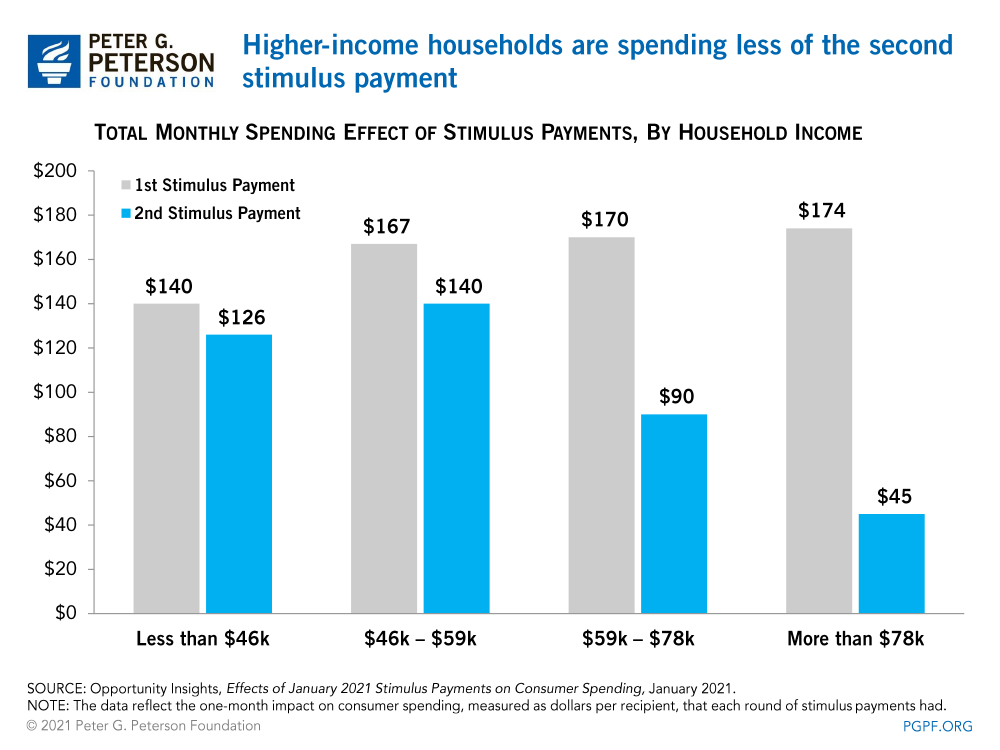
Those spending patterns for higher-income households were significantly lower than when they received the first round of payments — suggesting that such individuals may have recovered from the economic damage caused by the pandemic. As Congress and the President consider future legislation to mitigate the economic burden of COVID-19, such benefits and shortcomings of the program should be considered.
Image credit: Photo by Pool / Pool / Getty Images
Further Reading

Can Investing in the Stock Market Save Social Security?
Given Social Security’s unsustainable finances, some policymakers have proposed incorporating stock market investments as part of a solution.

Social Security Reform: Lessons From the Greenspan Commission
As the conditions of the 1980s mirror that of today, a commission is a viable and helpful framework worthy of consideration.

The President’s Budget Doesn’t Address National Debt, and Calls for Highest Defense Spending in History
For the second year in a row, the Trump Administration has submitted a budget that excludes key fiscal variables such as debt and deficit projections.