




7 Charts That Illustrate America’s Growing Fiscal Stress

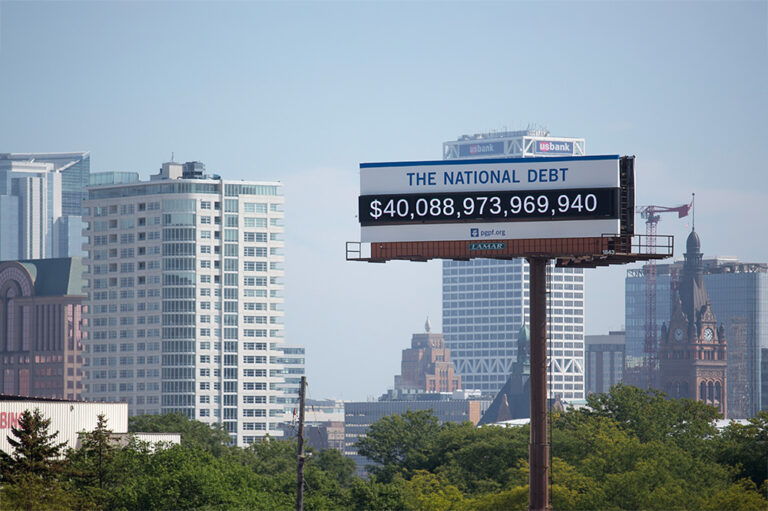
America’s fiscal situation is daunting, with key budgetary warning signs and hurdles approaching in the near term. In August 2026, the national debt surpassed $40 trillion, yet the debt continues to grow faster than ever. What’s more, the trustees for America’s key social safety net programs, Social Security and Medicare, warned that both programs’ trust funds will be depleted within seven years. A recent chart book created by the Brookings Institution’s Jessica Riedl provides a thorough examination of the federal government’s challenging fiscal situation. Here are seven key takeaways from that chart book.
1. Deficits May Be Even Worse Than Thought
In its most recent budgetary projections, the Congressional Budget Office (CBO) projected that the federal deficit would reach $3.1 trillion by 2036. However, CBO is required to provide projections based on current law, which assumes that policies like no tax on tips expire as scheduled. Lawmakers often extend such policies, as evidenced by the One Big Beautiful Bill Act (OBBBA) of 2025’s extension of tax cuts originally enacted by the Tax Cuts and Jobs Act of 2017. Assuming current policies remain in effect and tariffs return to pre-2025 rates, Riedl projects the deficit will reach $4.4 trillion in 2036, $1.2 trillion more than CBO’s projection.
2. A Daunting — but Plausible — Alternative Scenario for the National Debt
Spurred by higher deficits, the national debt could rise higher than CBO currently projects if policies set to expire are extended. If OBBBA is extended, tariffs are limited, and spending policies continue at current levels, the national debt could reach 137 percent of GDP by 2036. That would be 17 percentage points higher than CBO’s current-law projection. By 2056, the situation could be even worse under a current policy baseline: 243 percent of GDP compared to 175 percent. If economic conditions are worse than expected and interest rates on the national debt are higher than currently projected, debt could rise further yet, potentially reaching 379 percent of GDP in 2056.
3. Social Security, Health Care Programs, Interest, and Tax Cuts Have Driven Debt Since 2000
At the beginning of the century, the federal government had a budgetary surplus of 2.3 percent of GDP, but things have deteriorated significantly since then. Riedl shows that the key drivers of the national debt over the last quarter century include the aging of the population, high and rising costs of healthcare, interest on the debt, and sluggish tax revenues. The result: A budgetary deficit of 5.8 percent of GDP in 2026.
4. Social Security and Medicare Will Drive Deficit Growth
Over the next 10 years, Social Security and Medicare will drive deficit growth. In 2026, the budgetary deficit for Social Security and Medicare will be $0.9 trillion compared to $1.1 trillion for all other budget categories. By 2036, the deficit attributable to Social Security and Medicare will more than triple to $2.7 trillion compared to a relatively steady $1.6 trillion for all other.
5. Over the Next 30 Years, Social Security and Medicare Will Be Entirely Responsible for the Projected $138 Trillion Deficit
The above trend is projected to continue and become even more dominant over the long term. Over the next 30 years, Social Security and Medicare will be entirely responsible for the projected $138 trillion deficit. By contrast, the balance of spending for all other programs and general revenues will result in a surplus of $19 trillion.
6. Balancing the Budget Solely with Spending Cuts Would Require Dipping into Essential Programs
If lawmakers wanted to balance the budget in a decade with only cuts to federal spending, they would have to make extraordinarily deep reductions to programs seen as essential by many Americans. Instituting an even, across-the-board cut to all spending would require a 36 percent decrease to balance the budget in 2036. That would affect programs like Social Security, Medicare, veterans’ benefits, and defense; even cutting all other spending entirely except those four programs would not be enough to balance the budget.
7. Steep Changes are Required to Stabilize the Debt to 100 Percent of GDP
Lawmakers will need to enact significant changes to the federal budget to stabilize the national debt. To stabilize the debt to 100 percent of GDP, some combination of spending cuts or tax increases amounting to 4.3 percent of GDP would be required by 2036. A change of that size would result in interest savings of 1.4 percent of GDP. For comparison, individual income taxes are projected to raise 9.1 percent of GDP in revenues in 2036, and the same year, all discretionary spending — including national defense, veterans’ benefits, and income security — is projected to total 4.9 percent of GDP.
Conclusion
With current projections for deficits and debt on track to reach record heights, America’s fiscal challenges are serious and should be a priority for lawmakers. To meet that challenge, lawmakers will have to look past budget myths and misconceptions and find common ground for balanced, sustainable fiscal reform. Many solutions exist to put the country on a better fiscal path.
Photo by Greggory DiSalvo/Getty Images
Further Reading

Fed Raises Rates for First Time Since 2023 as Interest Costs Top $1 Trillion
High interest rates on U.S. Treasury securities increase the federal government’s borrowing costs.
Bond Market Movements Point to Growing Fiscal Risks
As ratings agencies have serially warned, U.S. debt growth is unsustainable, and global investors appear to be weighing the risks of financing U.S. deficits more heavily.
The Federal Government Has Borrowed Trillions. Who Owns All that Debt?
Most federal debt is owed to domestic holders, but foreign ownership is much higher now than it was about 50 years ago.