




What Is a Value-Added Tax and Should the United States Have One?

A value-added tax (VAT) is a type of general consumption tax that is levied on the value added to a good or service at each stage of production and distribution. Almost all developed economies have a value-added or similar consumption tax — but the United States does not.
Proponents of a VAT argue that it provides a broad-based, efficient, and sustainable revenue source, while detractors contend that it is regressive and creates burdensome compliance issues. However, as America faces unprecedentedly high deficits in the coming years, exploring new revenue sources could be one route to improving the unsustainable fiscal outlook.
How Do VATs Work?
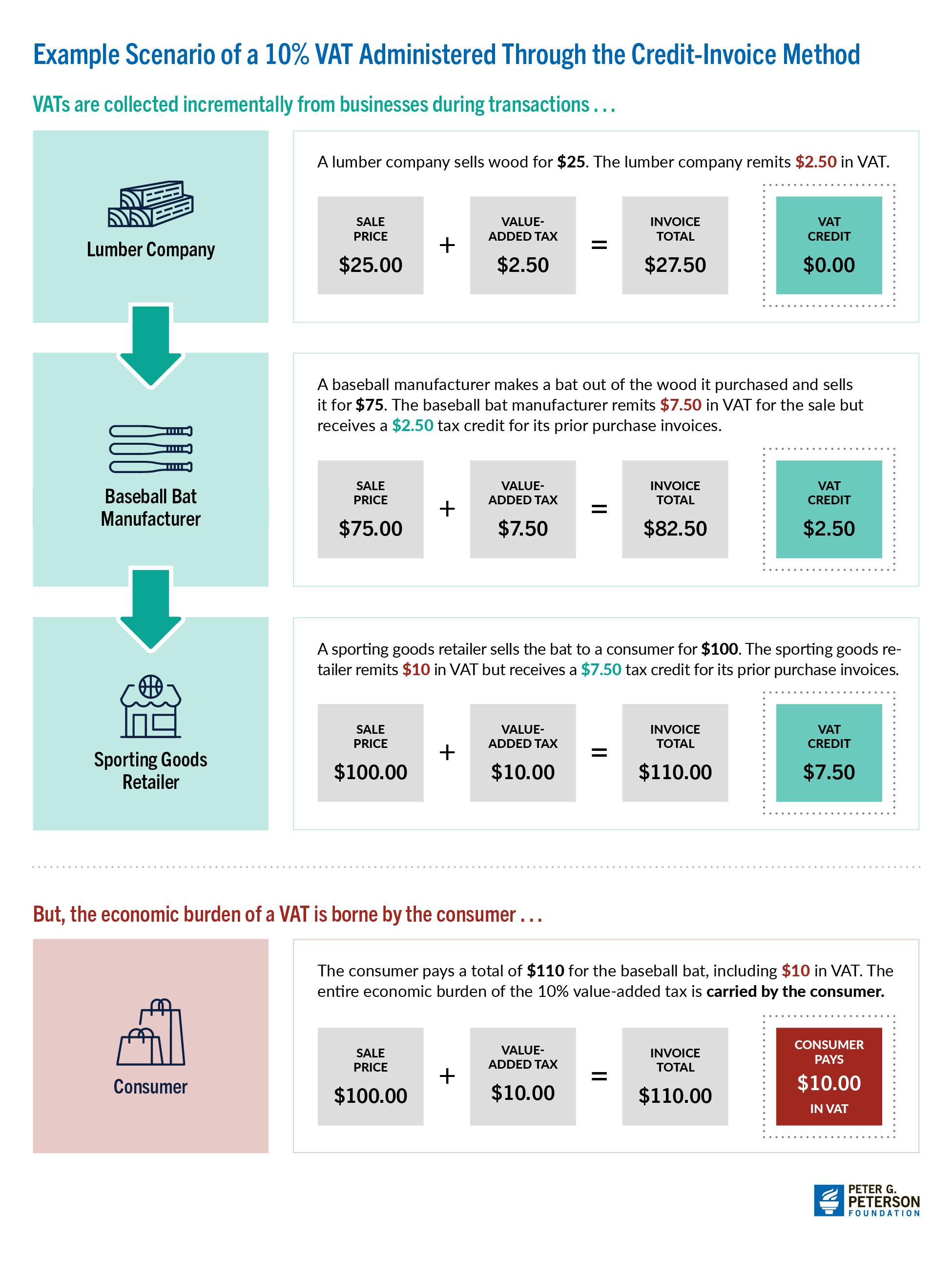
Value-added taxes are levied on the increase in value of a good or service at each stage of production and distribution. VATs are collected incrementally from businesses during transactions: both between businesses in the production process and with consumers at final sale. VATs are considered consumption taxes because their economic burden is ultimately borne by consumers, and the amount a taxpayer owes is determined by level of consumption, not by income or wealth.
There are multiple ways that a value-added tax can be administered, but according to the Joint Committee on Taxation, almost all countries administer their VAT through the credit-invoice method. Under that system, the value-added tax is paid to the government by the seller, similar to a sales tax. It is assumed that, although they remit VAT payments to the tax collecting authority, sellers pass the cost of the VAT on to purchasers. The tax rate is applied to the price of the good or service and is listed on the purchase invoice. Businesses or sellers receive a tax credit equal to the amount of VAT indicated on their purchase invoices, so they effectively pay taxes only on the amount of value their activity added to a good or service as it moves through the production and distribution chain. Consumers ultimately bear the economic burden of VATs.
For example, a sporting goods retailer buys a baseball bat from a manufacturer for $82.50 ($75.00 sale price with $7.50 in VAT). The retailer receives a tax credit for the $7.50 value-added tax indicated on the purchase invoice. It then sells the bat to a consumer for a total cost of $110.00 ($100.00 sale price with $10.00 in VAT). The retailer remits $10.00 to the federal government for the value-added tax, but the economic burden of the VAT is borne by the consumer.
Value-added taxes can also be administered through the subtraction method. Under this method, a business is taxed based on the difference between its purchases and taxable sales in a given period. Similar to the credit-invoice method described above, the subtraction method measures value added by comparing sales price to purchase price. The subtraction method applies the VAT to a net amount of value added, whereas the credit-invoice method applies the tax to gross sales with tax credits for gross purchases.
How Much Revenue Could a Value-Added Tax Raise for the United States?
A value-added tax could raise a significant amount of revenue for the federal government and could potentially eliminate the federal deficit. In 2023, federal revenues totaled 16.2 percent of gross domestic product (GDP), according to the Office of Management and Budget. By contrast, similarly wealthy countries that have a VAT, including Canada, the United Kingdom, and Germany, raised an average of 27 percent of GDP in taxes in 2023. Tax revenues came from a greater variety of sources for those countries:
- Social security contributions: 32 percent of revenues
- Individual income taxes: 23 percent of revenues
- Value-added taxes: 19 percent of revenues
- Corporate income taxes: 12 percent of revenues
Because the United States does not levy a value-added tax, the federal government has to depend to a much greater extent on income taxes. Establishing a VAT could meaningfully improve the nation’s fiscal outlook. In 2023, the federal deficit was 6.2 percent of GDP. If the federal government had imposed a VAT that raised an amount of revenue equal to the average of similarly wealthy countries, 5.1 percent of GDP, the U.S. deficit would have been only 1.1 percent of GDP. In fact, a VAT of that size would lead to a primary surplus of 1.3 percent of GDP, leaving only net interest costs as the driver of U.S. deficits.
The Congressional Budget Office projected that a 5 percent value-added tax would generate $3.4 trillion over 10 years. That would make it the fourth largest source of revenue for the federal government. However, the average VAT rate for similarly wealthy countries is 18 percent, according to the most recently available data. If the United States enacted a VAT that matched that rate, it would raise $12.2 trillion, assuming the revenue raising potential of a VAT remains constant as the tax rate rises.
How Might a VAT Impact the United States?
Implementing a federal value-added tax in the United States would be a major change in fiscal policy. A VAT could significantly improve the balance between spending and revenues, but it might raise concerns about its effect on the federal tax system. The Joint Committee on Taxation outlined key issues for Congress to consider related to VATs, including tax equity, international trade, and macroeconomic effects.
Tax Equity
A key consideration for policymakers in designing a tax system is tax equity, or fairness. Tax equity can be assessed in two ways:
- Vertically, where those with greater ability to pay bear a greater tax burden; and
- Horizontally, where those with similar income pay similar effective tax rates, otherwise referred to as the equal treatment of equals under the tax system.
Overall, the federal tax system is progressive, meaning those with higher income pay a higher tax rate. In 2022, the bottom 20 percent of earners paid an effective tax rate of 4 percent, while the top 20 percent paid an effective tax rate of 25 percent. That means that the U.S. tax system generally has vertical tax equity. A U.S. value-added tax would reduce vertical equity in the federal tax system, as all consumers pay the same VAT rate regardless of their level of income. However, many countries with VATs implement reduced rates or exclusions for goods and services that are deemed as household necessities. For example, the United Kingdom applies a 0 percent rate to food and beverages, water supplied to households, sewage, prescription drugs and women’s sanitary products, passenger transportation, new housing construction, and books and newspapers. A 2014 study from the Organisation for Economic Co-operation and Development found that reduced rates designed to support the poor successfully achieved their aim of reducing the regressivity of VATs.
Other proposals to address the distributional concerns of a VAT include offering a VAT rebate issued through the individual income tax. Penn Wharton Budget Model proposed a VAT rebate that would be structured as a refundable tax credit equal to the VAT rate multiplied by the lesser of a household’s wage and self-employment income or the poverty line for a family of four (half of that value for single filers).
International Trade
Many VATs administered in other countries operate under the destination principle, where imports are subject to tax while exports receive tax rebates. Taxing and issuing tax rebates at the time that a good crosses a border is called border adjustments. Border adjustments may appear to subsidize exports and penalize imports, but they instead equalize the tax treatment of goods that are traded internationally.
For example, suppose the price of an apple is $1 both overseas and domestically. If the United States were to impose a 10 percent VAT, the price of an apple would rise to $1.10 in the United States, as both the domestic and foreign apples would be taxed at the same rates. The same reasoning applies to tax rebates for exports. The overseas price for apples remains at $1 despite the price increase in the United States. To remain competitive in overseas markets, the federal government rebates $0.10 to apple exporters, so they can continue to sell their apples at the same overseas price.
Macroeconomic Effects
Economic analysis of an array of VAT proposals with various rates, rebates, and exclusions find that implementing a deficit-reducing VAT would boost growth in the long run. A study co-authored by the Baker Institute and Ernst & Young found that three policy scenarios in which VAT rates are set between 8.0 and 12.4 percent with various rebates and exclusions would increase GDP and reduce federal debt-to-GDP. A narrow-based VAT at 10.3 percent would boost GDP by 0.3 percent by the tenth year after implementation. That economic growth would be driven by the deficit reduction resulting from greater federal revenues. As fewer private savings are needed to buy up federal debt, more capital is available for private investment — effectively the reverse of the “crowd out” effect of rising national debt. In that same scenario, investment would rise by 5.6 percent in the tenth year. Those positive effects would outweigh the negative economic effects from lower consumption (-3.7 percent by the tenth year) and aggregate labor (-0.5 percent). A study by Penn Wharton Budget Model found similar results. In a scenario with a 1 percent VAT and a tax rebate, GDP would rise by 0.1 percent by the tenth year, mostly resulting from the positive effects of federal debt reduction.
Conclusion
As the United States adds to the national debt at an unprecedented rate, it is more important than ever that policymakers seriously consider fiscal reforms that can improve the country’s debt situation. Implementing a value-added tax could be one part of comprehensive fiscal reform that brings federal spending and revenues into balance.
Photo by Michael M. Santiago/Getty Images
Further Reading

What Is SNAP? An Overview of the Largest Federal Anti-Hunger Program
SNAP has a positive effect on poverty and food insecurity, with a relatively small effect on the federal budget.

Budget Basics: Federal Trust Funds
Federal trust funds bear little resemblance to their private-sector counterparts.

Spending on Veterans in the Budget
Federal spending for veterans has increased relatively sharply in the past two decades as scores of veterans returned home from extended wars in Iraq and Afghanistan.