




Breaking Down the $48 Billion of Airline Industry Payroll Support in Coronavirus Relief Legislation

On March 27, 2020, the president signed into law the Coronavirus Aid, Relief, and Economic Security (CARES) Act, the third phase of legislation designed to lessen the economic impact of the COVID-19 pandemic. One important component of the CARES Act was the Payroll Support Program (PSP1), which provided up to $32 billion in federal aid to maintain employment in the airline industry by providing funds to cover employee wages, salaries, and benefits. On December 27, 2020, policymakers enacted the 2021 Consolidated Appropriations Act, which provided an additional $16 billion in federal financial assistance to air carriers through the Payroll Support Program Extension (PSP2). Between both pieces of legislation, the total amount of funding has been allocated in the following ways:
- $40 billion to passenger air carriers
- $4 billion to cargo air carriers
- $4 billion to certain contractors providing services to air carriers
Upon successful application for the PSP2, an employer can receive assistance equal to the full amount paid to its employees between October 1, 2019 and March 31, 2020. In exchange, the airlines must avoid layoffs and furloughs through the end of March 2021.
As of January 29, 2021, the Department of the Treasury has disbursed over $34 billion of the total $48 billion allocated to air carriers through the PSP1 and PSP2.
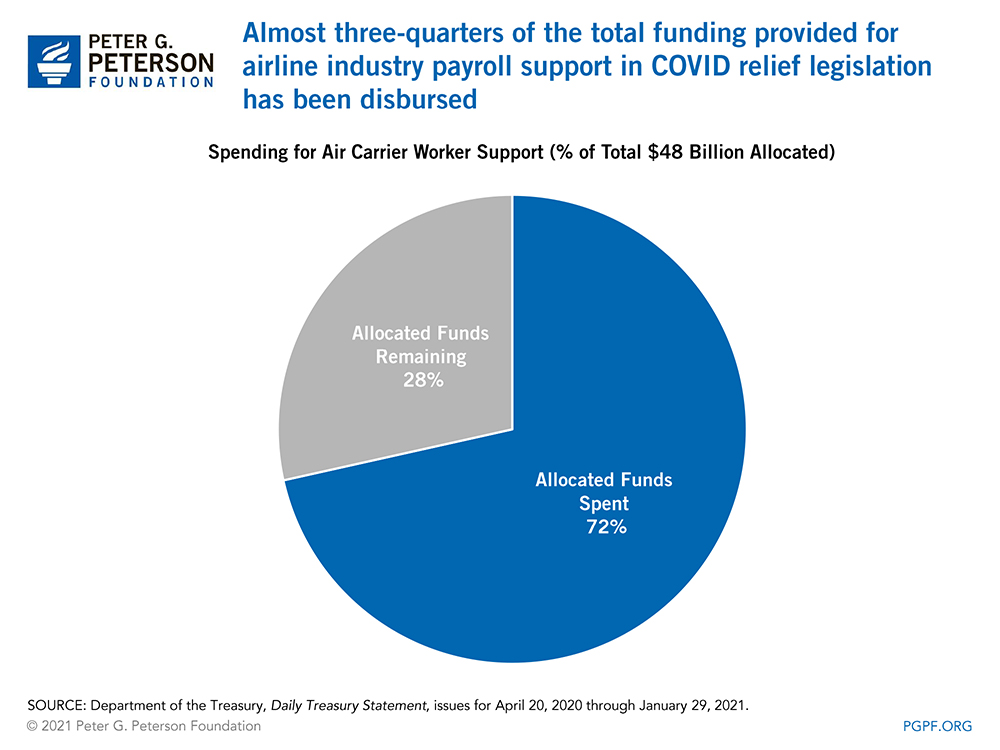
Image credit: Photo by Rob Carr/Getty Images
Further Reading
Growing Momentum for a Fiscal Commission in Congress
A fiscal commission would provide the space and structure for lawmakers to comprehensively review the entire budget and improve the fiscal path of the U.S.
86 Ways to Reform the Tax Code — and Why It’s Only Half the Solution
Tax policy is about trade-offs between how much revenue a tax will raise, who will bear the burden, and how a change will impact economic incentives.

In Their Own Words: Debt a Critical Issue for Voters in 2026 Election
Voters understand that the national debt has become too big to ignore as a major factor in America’s affordability crisis.