




Last Year’s Tax Law Did Not Simplify the System — It Added More Tax Breaks

The United States tax code is filled with loopholes, deductions, exemptions, credits, and preferential rates; such preferences are known as tax expenditures. Many economists, policymakers, and analysts believe it would help the economy to do away with some or all of those tax breaks to make the code more simple, efficient, and fair.
Last year’s tax legislation was a key opportunity to do just that, but in addition to adding significantly to our national debt, the Tax Cuts and Jobs Act actually increased the number of tax breaks.
According to the Joint Committee on Taxation (JCT), prior to enactment of the Tax Cuts and Jobs Act, there were 216 tax expenditures; now 223 exist.
While the Tax Cuts and Jobs Act eliminated or modified some existing tax expenditures, it also created new ones. Notably, the legislation reduced two of the largest tax expenditures—the state local tax and mortgage interest deductions. However, it also expanded some tax expenditures such as the Child Tax Credit and created new provisions such as the deduction for pass-through business income.
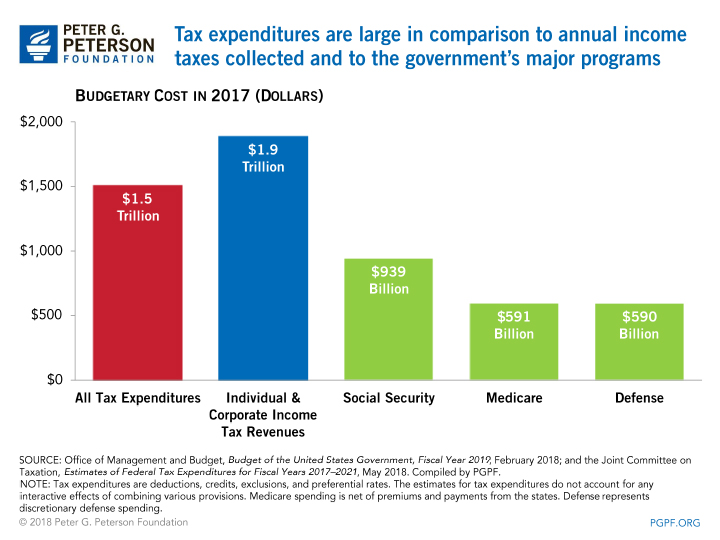
All told, JCT estimates that between 2016 and 2017 the total cost of all tax expenditures stayed roughly the same at $1.5 trillion. The total value of tax expenditures remains large in comparison to important government programs. For example, we spend more on tax expenditures than we do on Medicare and Defense combined. Because the Tax Cuts and Jobs Act didn’t reduce the overall cost of tax expenditures, there is still an opportunity to simplify the tax code and reduce future deficits by examining remaining tax breaks.
Image credit: Photo by Justin Sullivan/Getty Images
Further Reading
Payroll Taxes: What Are They and What Do They Fund?
Payroll taxes fund social insurance programs including Social Security and Medicare and are the second-largest source of revenues for the federal government.

IRS Staffing Cuts Will Reduce Revenues, Driving Deficits Higher
Reductions in IRS personnel decrease federal revenues, increase deficits, and significantly exacerbate the gap between taxes that are owed and taxes that are actually paid.
A Gas Tax Holiday Costs Billions, But Consumers See Only Marginal Savings
If the full savings from the gas tax holiday were passed on to consumers, the average licensed driver would only save approximately $8.90 per month.