




Rising National Debt Increases Costs for American Families and Businesses

One of the economically damaging effects of the rapidly rising national debt is the fact that it contributes to higher inflation and interest rates. But what does that mean, practically speaking, for American families and businesses?
A new report from the nonpartisan Budget Lab at Yale assesses the impact of the rising debt on affordability and the cost of living.
Yale’s report finds:
- Federal fiscal policy is a significant but often overlooked factor in the affordability of vehicles, homes, and small business loans.
- Legislative changes since 2015 have cumulatively raised the latest 10-year debt-to-gross domestic product projection by 49 percentage points.
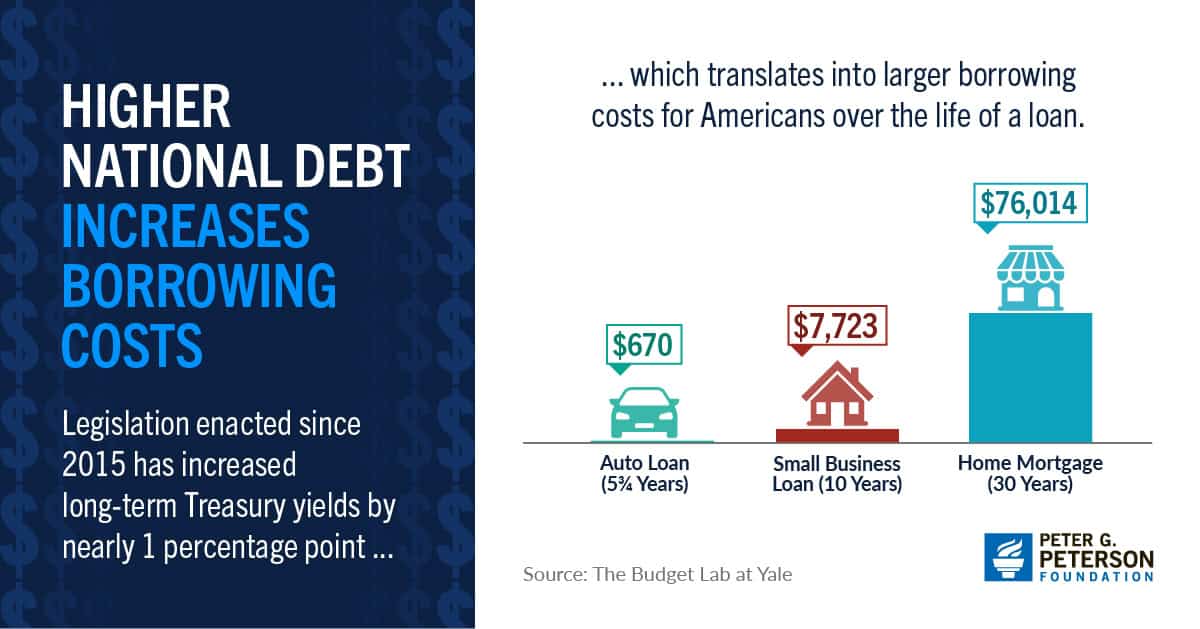
- Consequently, long-term Treasury yields have increased by approximately 1 percentage point since 2015, translating into larger borrowing costs for Americans. On average:
- Mortgage interest payments are higher by $2,534 per year, or $76,014 over the life of a 30-year loan.
- Small business loan payments are higher by $772 annually, or $7,723 over the life of a 10-year loan.
- Auto loan payments are higher by $117 annually, or $670 over the life of a 5¾-year loan.
As part of the report, the Budget Lab at Yale also released a companion Deficits and Affordability Tool, which calculates how much federal deficits are costing Americans personally on their loans.
This new report makes clear how the rising national debt comes at a real cost to Americans. Stabilizing the debt is a key component of improving the cost of living and building a stronger, more sustainable future for the country.
Further Reading

With $40 Trillion in Debt, Is the U.S. Headed for More Credit Downgrades?
Three successive downgrades of the U.S. credit rating should alarm elected leaders, but our national debt remains on an unsustainable trajectory.

What Is the Yield Curve, and What Does It Tell Us About the Economy?
Not only does the yield curve offer insights into the strength of the economy, but it also signals how investors view the government’s fiscal trajectory.

Can We Grow Our Way Out of the National Debt?
The gap between what economic growth can realistically deliver and what fiscal sustainability requires is too large to bridge without also addressing the structural imbalance between federal spending and revenues.